KenKen Explained: The Arithmetic Grid Puzzle
KenKen mixes sudoku-style logic with simple sums. How the cages work, and a few strategies for solving.
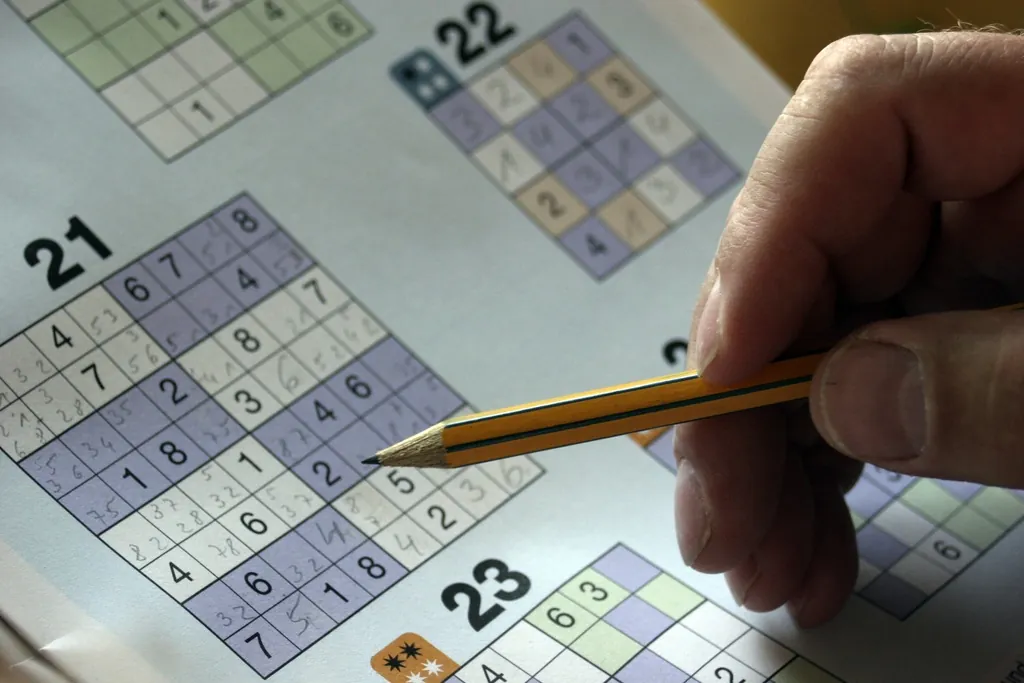
If you enjoy sudoku but miss doing a little arithmetic, KenKen might be your new favourite puzzle. It combines the no-repeats logic of sudoku with simple sums, and it comes in sizes from tiny 3 x 3 grids for beginners to large, demanding 9 x 9 ones.
Where it comes from
KenKen was invented by Japanese maths teacher Tetsuya Miyamoto, who designed it to help his students practise arithmetic and logical thinking. The name comes from the Japanese word ken, often translated as "cleverness" or "wisdom", so KenKen roughly means "clever squared". Puzzles in this style are also sold under other names, such as Calcudoku.
The rules
A KenKen grid is a square, for example 4 x 4 or 6 x 6.
- No repeats. In a 4 x 4 grid, each row and each column must contain the numbers 1 to 4 exactly once. A 6 x 6 grid uses 1 to 6, and so on.
- Cages. The grid is divided into groups of cells with bold outlines, called cages. Each cage shows a target number and an operation: +, -, x or ÷.
- Hit the target. The numbers in a cage must produce the target using that operation. A cage marked "7+" might contain 3 and 4, or 1, 2 and 4.
- Subtraction and division cages always have two cells, and you can apply the operation in either order. A "2÷" cage could be 4 and 2, or 2 and 1, in any order.
- Single-cell cages simply give you the number.
Unlike sudoku, there are no 3 x 3 boxes, and numbers can repeat within a cage as long as they are not in the same row or column.
Strategies for solving
Start with single cells. Write in any one-cell cages first. They are free numbers.
Look for cages with only one possibility. In a 4 x 4 grid, a two-cell "7+" cage must be 3 and 4, because no other pair adds to 7. A "3-" cage must be 1 and 4. A two-cell "12x" cage must be 3 and 4.
Use the no-repeats rule. If a row already has a 4, then any cage in that row cannot use 4 in that row. Combine this with cage options to narrow things down.
Write small candidate notes. For each cell, jot down which numbers are still possible. Cross them off as you go.
Use the row and column totals. In a 4 x 4 grid, each row adds up to 10 (1+2+3+4). In a 6 x 6 grid, each row adds up to 21. If you know most of a row, the remaining total tells you what is left.
Think about large multiplication targets. Big products often have few combinations. In a 6 x 6 grid, "60x" across three cells could be 3, 4 and 5 or 2, 5 and 6, and the cage shape will often rule one out.
Why people love it
KenKen keeps arithmetic skills sharp without feeling like homework, and the logic is satisfying in the same way as sudoku. Small grids are great for children learning addition and multiplication; larger ones are a real challenge for adults. Teachers sometimes use it alongside maths crossword puzzles to make number practice more playful.
For more puzzles in the same family, see our guide to types of word and number puzzles.
KenKen is a registered trademark of its owners. Crossword Puzzles Game is an independent site with no connection to the brand.